How to Choose a Crib Mattress: Firm, Tight, Bare
Last updated: September 29, 2026
This article contains affiliate links. If you buy through them, we may earn a commission at no extra cost to you. Full disclosure here.
You are about to read more about crib mattresses than you ever wanted to. Most of it will be about materials. Almost none of it will be about what actually decides whether the mattress is safe — which is not the material at all, but three measurable things: how firm it is, how it fits the crib you own, and what gets added to it after it arrives.
The crib is the one place in your home where safety comes first and comfort comes second. Every recommendation below follows from that order — and it is the reason a few of them will tell you not to buy something you were about to buy.
The three things that actually matter
| What | The test | Why it matters |
|---|---|---|
| Firm | Press your palm flat into the middle. Your hand stays on the surface instead of sinking into it. | A soft surface can form a pocket around a sleeping baby’s face. |
| Tight | Put it in the crib, push it into one corner, and look at the opposite corner. | Any gap at the edges is a place a baby can get wedged. |
| Bare | A fitted sheet, and nothing else. | The crib should be bare. This one is not a preference. |
1. Firmness: the test you can do yourself
Press your palm flat into the middle of the mattress. Your hand should rest on top of it, not sink into it. The guideline from the American Academy of Pediatrics is simply a firm sleep surface — and the practical translation is that the surface should not indent under your baby’s head.
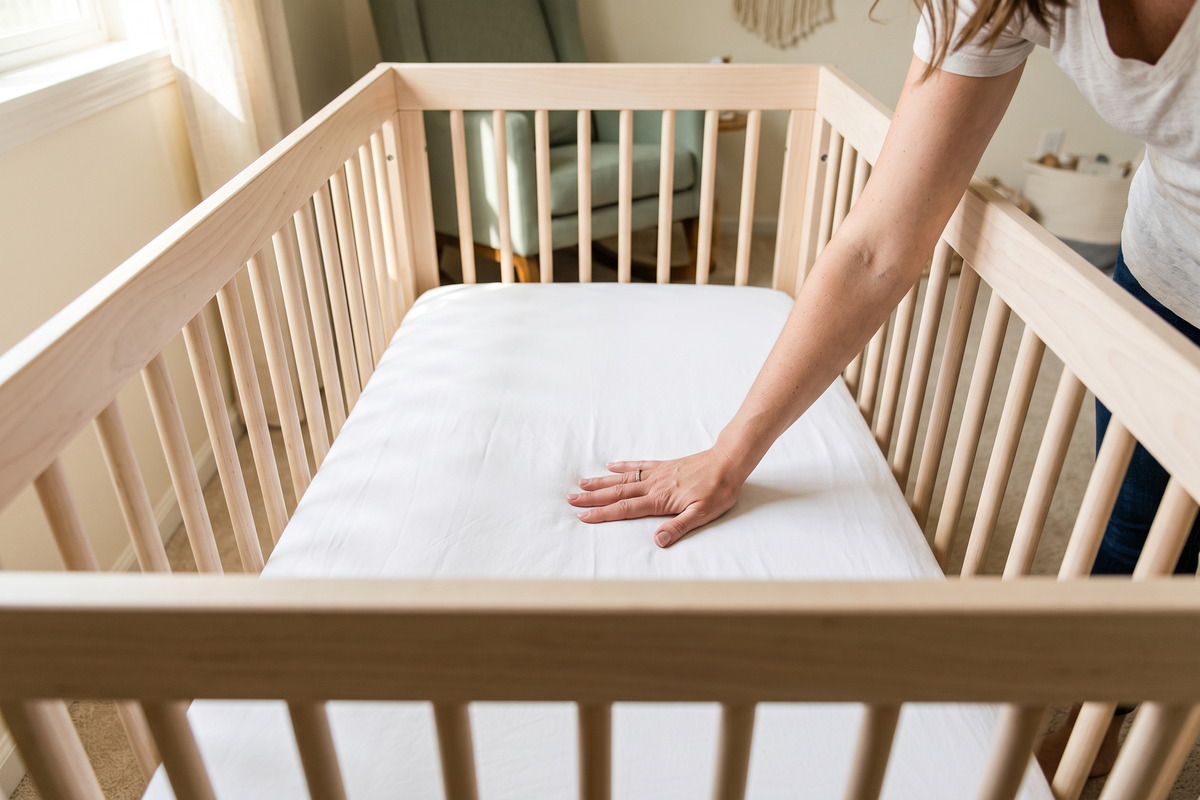
The material to be careful with is the one marketed as comfort: memory foam. Foam that holds the shape of your hand can create a pocket where a sleeping baby breathes the same air twice. That is the mechanism behind the recommendation, and it is the reason “soft” and “supportive” are not selling points in a crib.
Firmness is not just advice, either. A crib mattress sold in the US has to meet a federal standard under 16 CFR part 1241, which covers the sleep surface firmness itself, along with dimensions, seam stitching and the springs inside. The maker has to have it tested by a third-party lab and hold a certificate citing that rule. Every new mattress on the shelf, including the cheapest one, has cleared the same floor.
2. Fit: the numbers, and why a finger count is not enough
A full-size crib is built to an interior of 28 inches by 52 3/8 inches, with a tolerance of about five-eighths of an inch, under 16 CFR 1219. A mattress sold as full-size has its own standard, 16 CFR 1241, and must measure at least 27¼ inches by 51 5/8 inches.
Subtract one from the other and you can see the margin you are working with: at nominal dimensions, about three-eighths of an inch per side. In the worst case allowed by the tolerances, roughly two-thirds of an inch. That is not much room, and it is why “it looked about right” is not a fit test.
So do this instead. Put the mattress in the crib and push it firmly into one corner. Then look at the corner diagonally opposite.
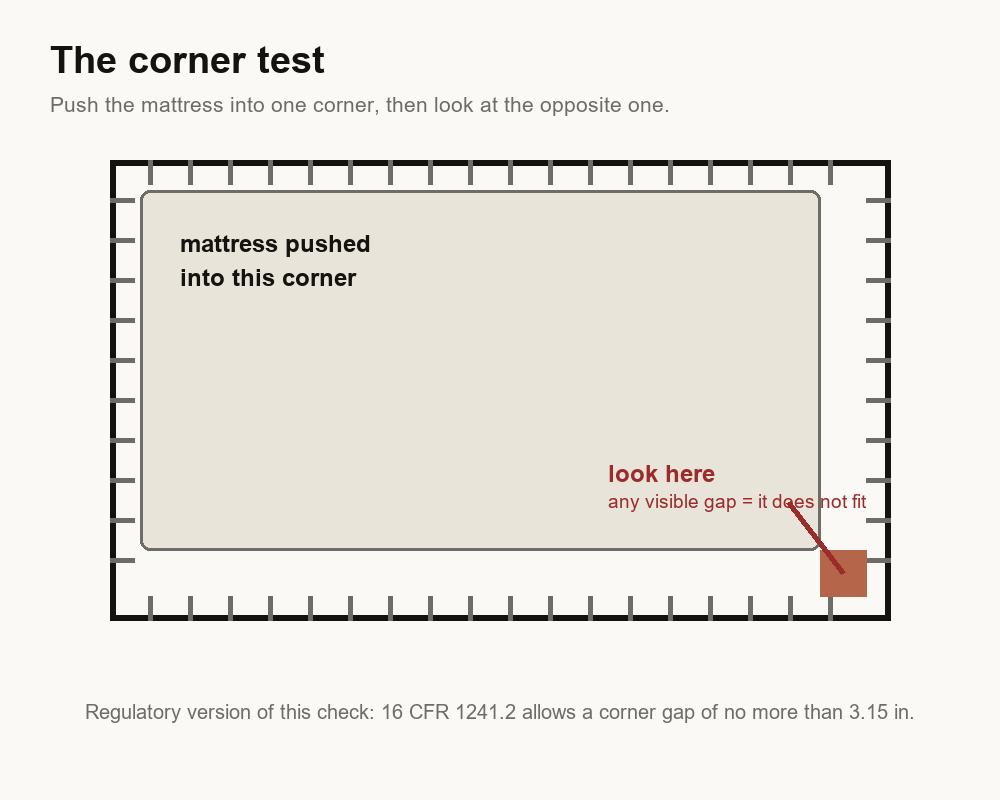
The regulatory version of this check is a corner-gap measurement — under 16 CFR 1241.2 no more than 3.15 inches, tested with a cotton sheet washed twice in hot water — but you do not need the lab. If you can see the sheet between the mattress and the crib side, or slide two fingers into the gap, it does not fit.
And if you are buying a mattress and a crib separately, buy the mattress for that crib. The manufacturer’s own list is the only reliable pairing. After-market mattresses have to match the original or be larger and carry the compatible model on the label; a size measurement alone does not count as compatibility. If you are still deciding between a crib and a bassinet, we went through that separately in crib vs. bassinet: what you actually need. One trap that catches people buying online: cribs come under two different standards. Standard cribs follow 16 CFR 1219; mini cribs, portable cribs and play yards follow 16 CFR 1220 and 1221, with different dimensions.
3. Bare: what stays out of the crib
The AAP’s list of things that do not belong in a crib is short and absolute: pillows, blankets, quilts, comforters, bumper pads, soft toys, and mattress toppers. The AAP says toppers make the surface softer and are not appropriate for infants under one year. Not “try to avoid” — keep out.
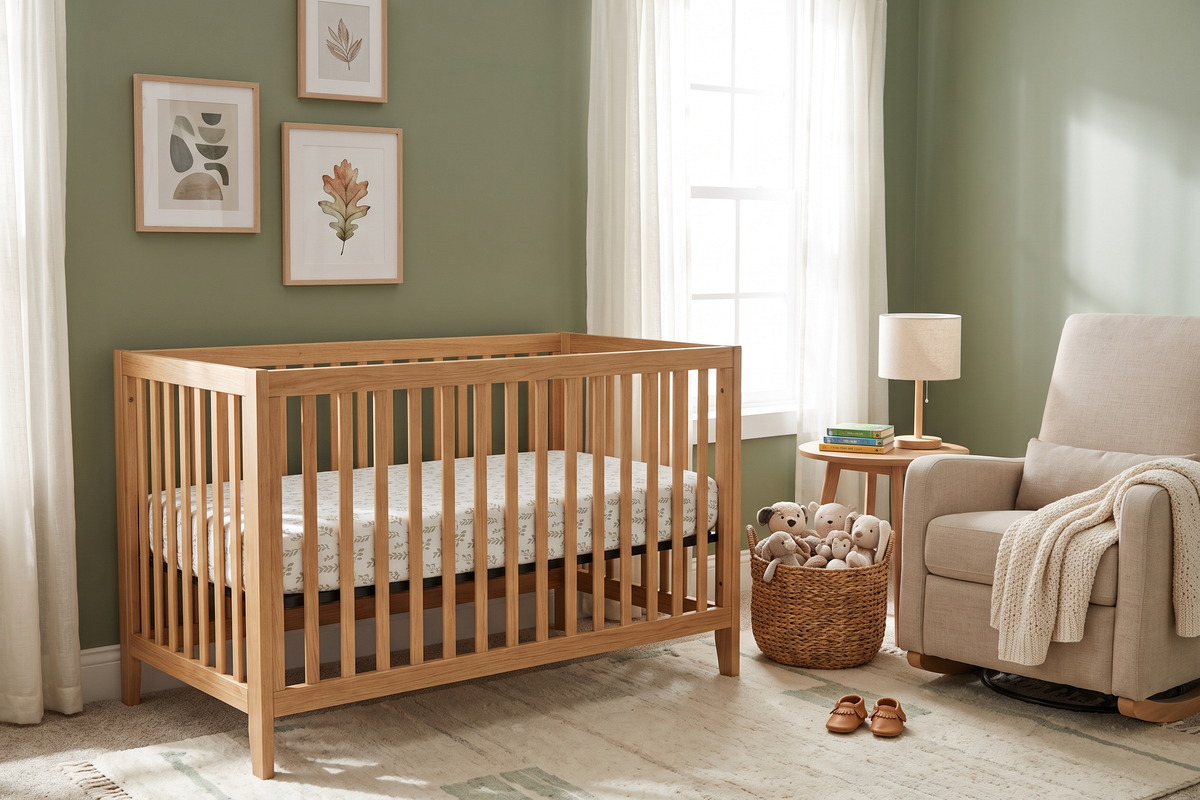
People will give you pillows, bumpers and blankets because they are pretty, and because they mean well. Every one of them belongs on that list. A prettier crib is never worth a risk to the baby sleeping in it.
For warmth, a sleep sack is the thing that fits this rule: it is worn rather than laid over the baby, so the crib stays empty and the surface stays firm.
How much softer do they actually make it? A peer-reviewed study that measured sleep surfaces with a validated instrument found that a single folded fleece blanket added 2.3 to 6.5 mm of softness; folded twice, 4.8 to 11.6 mm; three times, up to 21.8 mm. A firm pillow added 4.0 to 20.9 mm, and a soft pillow 24.5 to 46.4 mm — on the same scale where the whole range of household sleep surfaces measured 7.4 to 36.9 mm. Adding something soft does not shade the surface; it changes its category.
What “breathable” does and does not mean
“Breathable” is a design feature, not a safety category. It is not defined or tested by the CPSC, and it is not part of what 16 CFR 1241 requires. It describes how air moves through the mattress. It does not change how a baby should sleep, and it is not a substitute for placing a baby on their back on a firm, flat surface. If you want a breathable mattress, buy one for the reason it actually helps — airflow and heat — and not as permission to bend the sleep rules.
One date worth knowing when you shop: mattresses manufactured after May 3, 2026 must meet ASTM F2933-25 with the CPSC’s modifications; those made between August 15, 2022 and that date meet F2933-21. The obligation attaches to when the mattress was made, not when you bought it, so new stock can be old stock.
Foam, coil, or mesh: how to choose between them
The material matters less than the three tests above. What it does change is your daily life with the mattress:
- Foam is lighter, which matters at 3am when you are changing a sheet one-handed.
- Coil (innerspring) is heavier and tends to keep its shape, at the cost of lifting it every time the sheet comes off.
- Mesh or breathable core is a third option, usually the lightest of the three and the easiest to air out.
Whatever you choose, ask the manufacturer one question they can answer without marketing language: is this mattress compliant with 16 CFR 1241, and does it carry an independent certification for emissions? A mattress that meets the federal standard has been tested for the things the standard covers. A certification for chemical emissions covers a different set of worries, and it is worth asking about separately.
Mattress protector: the one accessory parents disagree about
The strictest reading of the sleep guidance is a fitted sheet and nothing else. In practice, most parents add a waterproof protector underneath the sheet, because a crib mattress is expensive and gets wet regularly. You will get advice from every direction in the first year; on this one, keep it simple: firm, tight, and bare.
First, check the mattress you bought. Some crib mattresses already handle this on their own: they come with a waterproof layer built into the surface, or with a removable wipe-clean waterproof cover. The Newton Baby Waterproof mattress, for one, quilts that layer into the toddler side of the cover on purpose, so the infant side stays fully breathable — and Newton’s own guidance is to skip a pad in the first year for exactly that reason. If yours is one of those, you do not need a separate protector, and the maker’s guidance wins. The case for adding one is the mattress with no built-in protection at all: most foam mattresses, and anything with a fabric cover you cannot wipe.
If you do use one, hold it to the same standard as the mattress — it has to be fitted, thin and flat under the sheet, and it cannot change how firm the surface feels; if it does, it comes off. The one we would pick is the crib-size organic cotton protector from Sleep & Beyond, which is cut for a crib mattress, goes under the fitted sheet, and stays a protector rather than a topper.
What we would skip
- A second-hand mattress you cannot verify. Firmness is the whole point, and foam and springs both soften with use. Check the recall list first if the mattress is not new.
- Any topper, however nice the material. It is on the keep-out list, and it turns a firm mattress into a soft one.
- A protector on a mattress that already has waterproofing. If the layer is built into the surface, or you got a removable wipe-clean cover with the mattress, the extra protector buys you nothing.
- A breathable mattress bought as a substitute for back-sleeping. The two are not interchangeable.
- Buying the mattress before the crib. Fit is specific to the crib, and returns on mattresses are miserable.
- Assuming “crib size” means one size. Standard and mini cribs follow different standards and do not share dimensions.
The one-page version
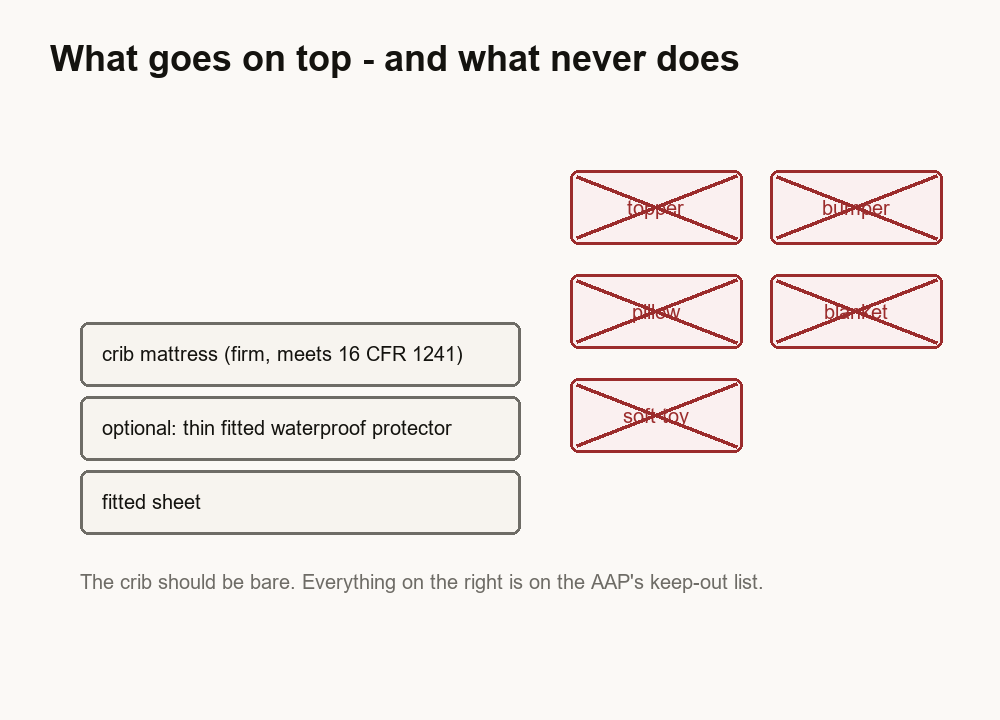
Press the mattress: your palm should not sink. Put it in the crib and push it to one corner: no gap should show at the opposite corner, and two fingers should not fit. Add a fitted sheet and nothing else — no topper, no bumper, no pillow. The rest of the sleep setup, month by month, is in the baby sleep schedule guide. Check that the mattress meets 16 CFR 1241 and that your crib meets 16 CFR 1219 (or 1220 for a mini). You do not need the expensive one; you need the one that is firm and fits. If the budget is the constraint, the same logic runs through how to set up a nursery for under $1,500.
Then stop researching and go to sleep, because one of you should. And the next time someone tells you a pretty topper would make the crib cosier, you already know what to answer.
Specifications and prices are set by the retailer. Confirm the standard and the dimensions on the product page before you buy.