
Nursery Wall Decor for Renters: 7 Ideas That Do Not Cost You the Deposit
Last updated: September 24, 2026
This article contains affiliate links. If you buy through them, we may earn a commission at no extra cost to you. Full disclosure here.
You cannot paint, you cannot drill, and in eighteen months somebody will walk through the empty room with a checklist. That is the entire problem of decorating a nursery in a rental — and it is solvable, as long as you choose the method before the design.
Seven approaches below. All of them come off, none of them cost you the deposit, and the most expensive one still costs less than repainting the room.
The rule that comes before all of this
Nothing goes above the crib. Not a shelf, not a frame, not a garland, not a print on a nail. A crib is the one place in the house where the safe-sleep guidance is absolute: the sleep surface stays clear, nothing hangs low enough to be reached, and no cord runs anywhere a small hand can find it.
Everything in this article belongs on the wall you see from the door, on the wall opposite the crib, or above the changing table — which, unlike the crib wall, is where you actually stand and look at something for months.
The seven ideas, compared
| Idea | Cost | Effort | Deposit risk |
|---|---|---|---|
| 1. Peel-and-stick mural on one wall | $40–120 | Medium (one afternoon) | None, if the wall is smooth and the paint is cured |
| 2. Picture ledge on adhesive strips | $15–40 | Low | None — strips come off with a slow pull |
| 3. Removable decals | $10–30 | Low | Usually none; they lift at the edges on textured walls |
| 4. Fabric banner or garland | $8–25 | Low | None with clips or a tension line |
| 5. Leaning art on a shelf or the floor | $0 | None | None |
| 6. One large framed print on strips | $20–60 | Low | None, under the strip’s weight limit |
| 7. Clip-string gallery | $10–25 | Low | None with the smallest hooks |
1. A peel-and-stick mural, on one wall only
This is the only option on the list that changes the room instead of decorating it. A mural is a single printed panel sized to your wall — not a repeating pattern — which is what makes it work in a rental: you buy one piece, you hang one piece, you take down one piece.
What decides whether it works is not the mural, it is the wall. Peel-and-stick needs a surface that is smooth, dry and painted with a matte or eggshell finish. On a textured wall it will lift at the seams within weeks. On paint that was applied recently it can pull the paint with it when you remove it — give new paint a few weeks to cure before you cover it.
Two rooms to avoid: the wall that backs onto a bathroom, and an exterior wall that sweats in winter. Humidity is what kills the adhesive, and it does it slowly, from the edges in.
How to size it: measure the width and the height of the wall you are covering and order to the larger of the two. Then leave the crib wall plain. It is the one wall nobody sees once the crib is against it, and it is the one wall that has to stay completely bare.
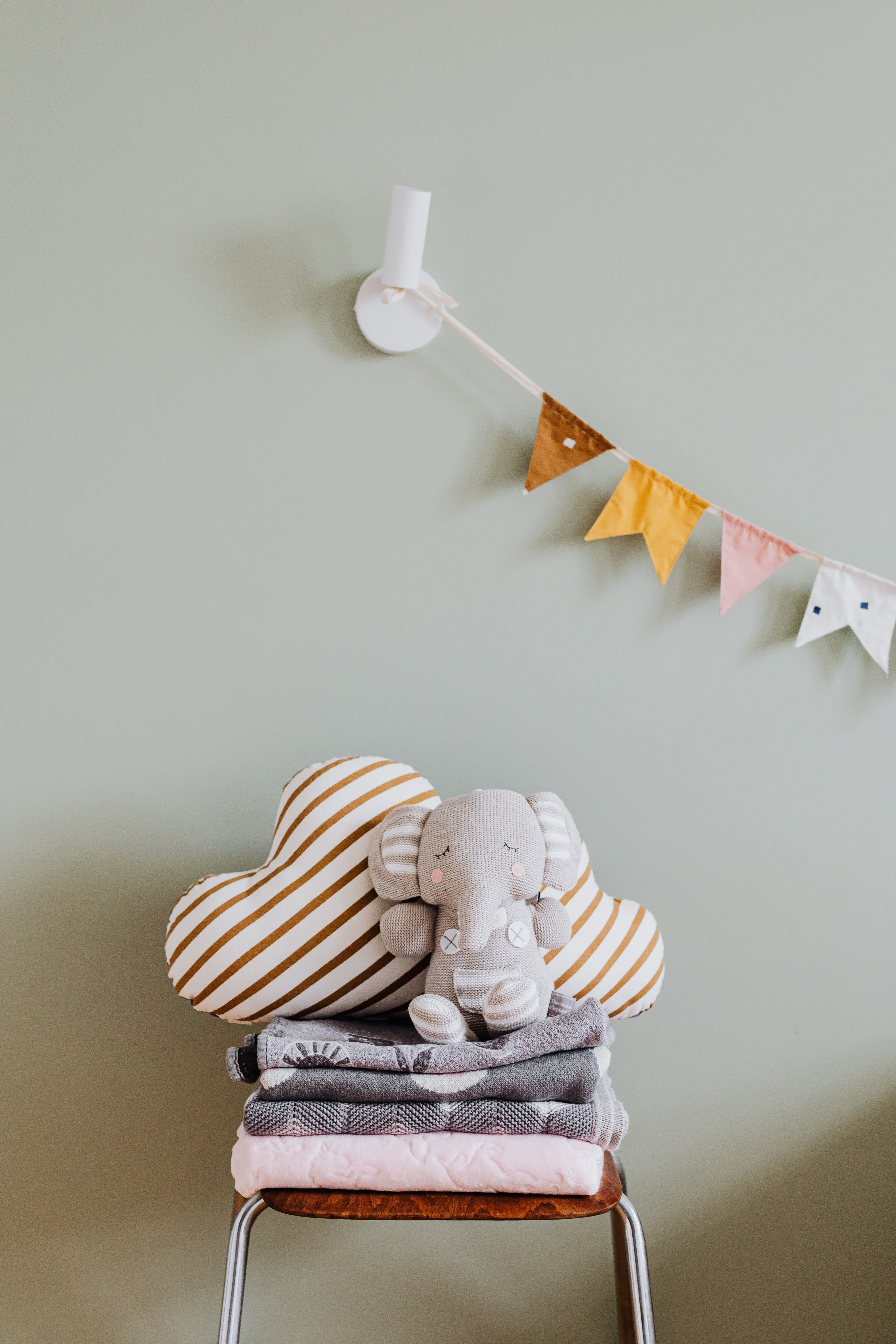
2. A picture ledge, not a picture hook
A narrow ledge fixed with adhesive strips holds three or four small frames and lets you change the art without touching the wall again. It also solves the problem frames usually create in a small room: you stop hunting for a matching set, because the ledge does the arranging.
The limit is weight, and it is lower than people expect. Adhesive strips hold more than they say on the box in a laboratory, and less than they say in a warm room. Keep frames light, and never put a ledge above the crib.
3. Removable decals: the cheapest version that still looks intentional
Decals are the entry point, and they are genuinely fine — with one condition: they need the same smooth wall as the mural, for the same reason. On a textured wall they fail at the edges and start to curl.
The trick that makes decals look deliberate instead of random: place them in a cluster, at the height of your eye when you stand at the changing table, and leave the rest of the wall empty. Decals spread evenly across a wall read as stickers. Decals in one grouped composition read as a decision.
4. A fabric banner or a garland
Fabric is the cheapest way to add softness and colour, and it is the only option here that also absorbs sound — which matters more than it sounds in a small room with hard floors.
Hang it with clips on a line, or with a tension rod between two walls if the room allows. Never over the crib, and never low enough to be grabbed from inside it.
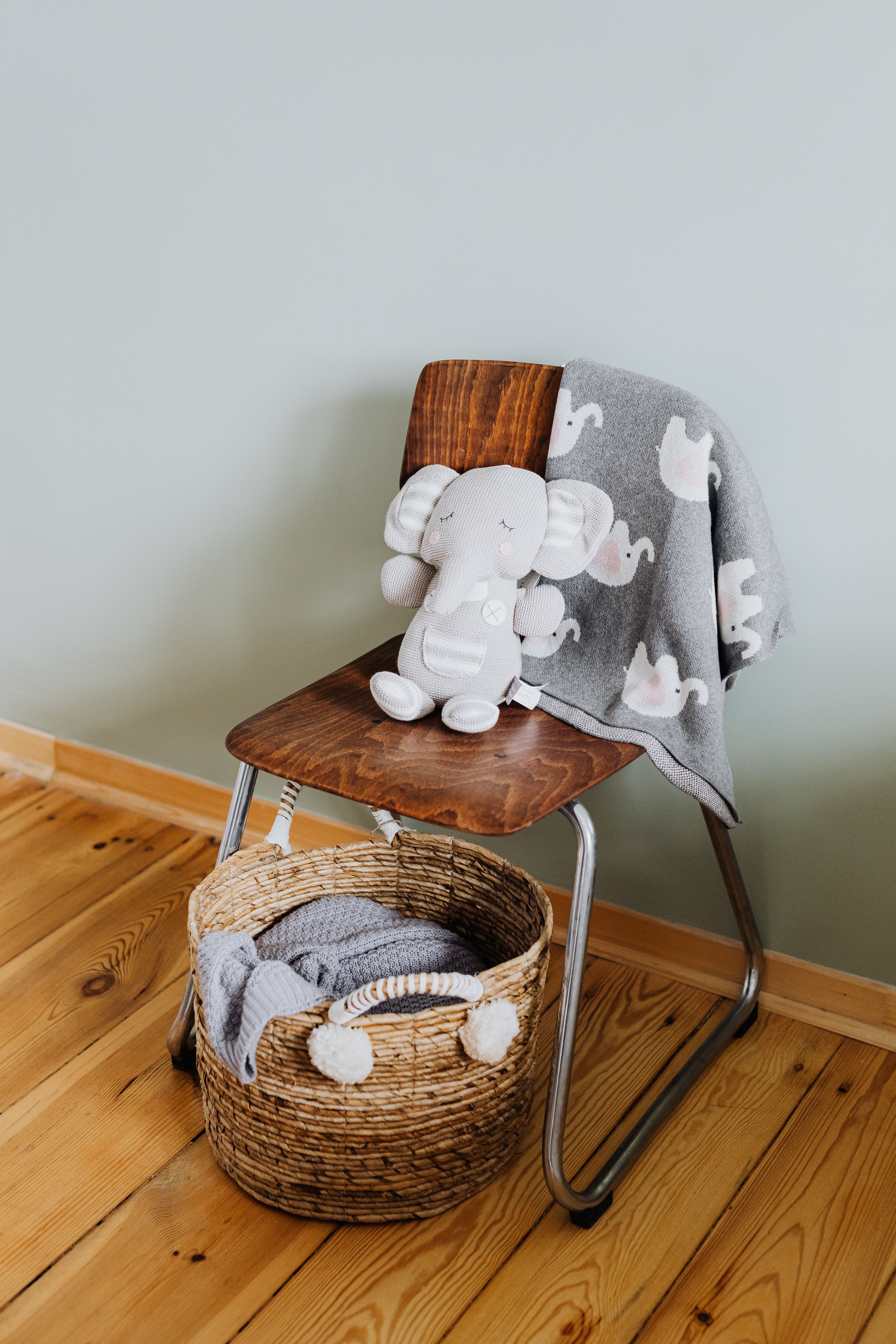
5. Leaning art
A print or a canvas leaning on a shelf, on the changing table, or on the floor against the skirting board costs nothing, damages nothing, and is the fastest way to put something on a wall without touching it. In a small nursery it is also practical: nothing is above head height, and you can move it when the furniture moves.
6. One large framed print, on strips
One big piece beats four small ones. A single 18×24 print on adhesive strips gives the room a focal point without a row of hooks, and it reads as a considered choice rather than a collection. Choose the lightest frame you can tolerate — the strips are rated by weight, not by size.
7. A clip-string gallery
A line of string with small clips holds prints, postcards, the first sonogram, and photos of the family walking in. It uses the smallest possible hook, holds almost nothing, and changes every month, which is exactly what you want in a room whose occupant changes every month too.
What we would actually buy
If you are going to spend on one thing, spend it on the wall you look at from the door. These are the peel-and-stick options we would start with, and they come down the same way they go up:
- A jungle safari mural — giraffe, elephant and hot-air balloons; the one that reads as a picture rather than a pattern, which is what you want on a single wall.
- A cottagecore meadow mural in pastels — the quiet option. It reads as a painted wall from across the room and as a meadow up close.
- A hot-air balloon mural in clouds — the one that fits a room with a sloped ceiling or a small window, because the sky fills the awkward space.
- A dinosaur mural for an older toddler — for the child who has opinions. Works in a playroom corner as well as a bedroom.
- A soft animal set — not a wall product, but the cheapest way to make a shelf look finished, and the only thing on this list a baby can eventually play with.
All of them are peel-and-stick, so the removal instructions below are the same for each one.
What we would skip
- Heavy frames on adhesive strips. The strip holds; the frame’s corner does not. If it is glass and bigger than a sheet of paper, treat it as a two-person, two-strip job or skip it.
- Decals on textured walls. They look fine on day one and curled on day twenty.
- Wallpaper on the wall behind the crib. You pay for a surface nobody sees and you put a decorative element where the safety rule says nothing goes.
- Anything with a cord. Including the plug-in wall light that looks perfect in the photograph.
- Painting the room. The repaint at move-out costs more than everything else on this list combined, and it is the one change the deposit actually covers.
Removing it without taking the paint with it
Warm the panel with a hairdryer on low, pull at a low angle — almost back on itself, not out from the wall — and keep the backing paper. Peel-and-stick is designed to be removed, but it is not designed to be rushed: the paint comes off when the adhesive is cold and the pull is perpendicular.
Questions we get asked
Does peel-and-stick wallpaper damage paint?
It can. If the wall was painted recently, if the paint is old and chalky, or if you pull straight out instead of at an angle, it may take a layer with it. On a well-cured, smooth wall, removed slowly, it usually comes off clean.
Can I wallpaper just one wall?
Yes — that is the standard version of this. One wall, the one you see from the door, and the rest stays neutral.
How much do I need?
Measure the width and the height of the wall and order to the larger. A mural is one panel sized to your wall; a repeating pattern needs extra for the repeat. When in doubt, measure twice and buy once — a second order from a different print run is a different colour.
What about textured walls?
They do not hold. Adhesive needs flat contact across the whole surface, and a textured wall only gives it contact at the peaks.
Will it survive a humid room?
Skip the wall that backs onto a bathroom. Everywhere else, it is fine.
We update this guide as designs and prices change. Prices and availability are set by the retailer — always confirm them on the product page before you buy.