Crib vs Bassinet: What You Actually Need for the First 6 Months
Last updated: September 24, 2026
This article contains affiliate links. If you buy through them, we may earn a commission at no extra cost to you. Full disclosure here.
Every first-time parent hits the same wall somewhere around week 30: the registry list says you need a crib, a bassinet, a mattress, sheets for both, and a place to put the bassinet. That is a lot of furniture for a person who will not roll over for another five months. So it is worth asking the honest question — do you actually need both?
The short answer: most families use a bassinet first and a crib later, but you can skip the bassinet and put a newborn straight into a full-size crib if the crib fits in your room. What you cannot do is skip a safe, flat, firm sleep surface. That part is not optional.
Here is how the two compare, when each one earns its place, and what we would actually buy if we were setting up a small apartment from zero.
Crib vs bassinet, side by side
| Crib | Bassinet | |
| How long it lasts | About 2 to 4 years, convertible cribs longer | Usually 3 to 6 months, or until your baby hits the weight limit |
| Typical footprint | Roughly 30 x 54 inches for a full-size crib | Roughly 30 x 17 inches, and most have wheels or a light frame |
| Where it goes | Nursery, or beside your bed if the room allows | Beside your bed, which is the main reason people buy one |
| Mattress | Sold separately: firm, flat, tight to the frame | Comes with its own thin, firm pad or mattress |
| Portability | None. It stays where you build it | Usually movable from room to room |
| Secondhand | Easy to find, but check the manufacture date and hardware | Cheap secondhand, but buy a new mattress or pad |
What a bassinet is actually for
A bassinet is not really about the baby. It is about you — specifically, about the first months of night feeds. Pediatric sleep guidance recommends keeping a baby in the same room as the parents for at least the first six months, on a separate sleep surface. A bassinet is the smallest, cheapest way to do that when your bedroom has no room for a crib.
It also solves a real problem: a newborn wakes every two to three hours. Walking to another room ten times a night is a different life than reaching half a metre to the side.
The hours that are not sleep are holding hours, and a soft structured carrier is what makes them possible with your hands free — for the day, never as a sleep surface.
Choose a bassinet if:
- Your bedroom fits a bassinet but not a crib
- You want the baby within arm’s reach for the first months
- You plan to travel or move rooms during the day
- You are renting and will move before the baby turns one
Skip it if:
- A full-size crib fits beside your bed (measure before you decide)
- You want to buy one piece of furniture instead of two
- You are on a tight budget and the crib is the priority
- Your baby is large or a fast grower — bassinets have firm weight limits, often 20 to 25 pounds, and some babies reach that before six months
What only a crib does
The crib is the only piece that survives the first year. It takes the baby from “sleeps on his back and does not move” to “pulls up on the rail and throws a stuffed animal at the wall” — which is why the safety standards matter more here than anywhere else in the nursery.
In the United States, cribs sold since 2011 must meet mandatory federal safety standards, which is why drop-side cribs disappeared from the market. That is also why a hand-me-down crib from 2005 is a bad idea even if it looks perfect, and why you should always check the manufacture date and whether the model has ever been recalled.
Choose a full-size crib if:
- You want one purchase to cover two to four years
- You have the floor space, even in a small room
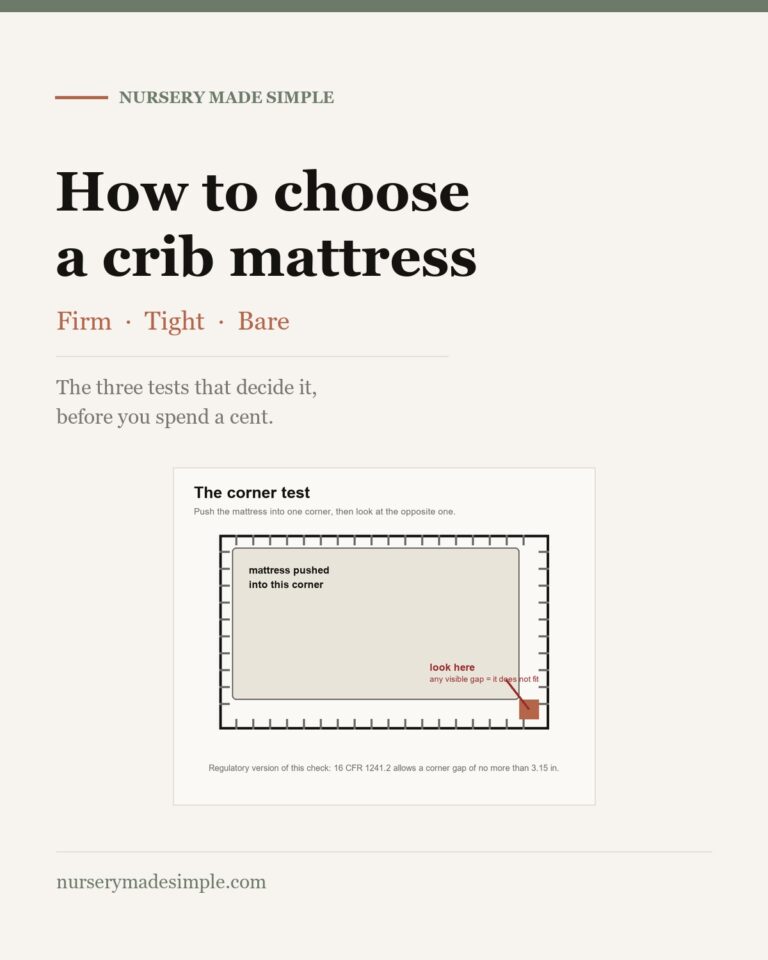
- You want a mattress you can choose for firmness rather than accepting whatever pad comes in the box
- You want the option to convert to a toddler bed later
If you are tight on space, a mini crib is the middle path: about 24 x 38 inches, still a real flat mattress, still usable past the bassinet stage, but short enough to tuck into the corner of a small bedroom.
The safety rules that apply to both
These are the same for a bassinet, a mini crib and a full-size crib:
- Bare is safest. A fitted sheet on a firm, flat mattress. No bumpers, no pillows, no loose blankets, no plush toys in the sleep space. Crib bumpers were banned for sale in the US under the Safe Sleep for Babies Act.
- Back to sleep, on a firm surface, every sleep.
- Nothing that raises the mattress at one end, unless a clinician specifically tells you to.
- Check the weight and height limits of a bassinet in the manual and move your baby out as soon as either is reached, not “when it looks too small”.
- Follow your pediatrician over any blog, including this one, for anything about your baby’s breathing, sleep or growth.
What we would actually buy
For a small apartment, the order that makes sense to us is:
- A full-size or mini crib that fits your bedroom or the nursery, with a new firm mattress. This is the piece that has to be right.
- A bassinet only if the crib cannot fit where you sleep. If your space allows it, a mini crib replaces both.
- Two fitted sheets per sleep surface, no more. Everything else is a gift somebody will buy you.
- A fitted waterproof protector for each sleep surface. A crib mattress gets wet: spit-up, leaks, the 2am change. A protector keeps the mattress clean without turning the sleep surface into plastic – the one we would pick is organic cotton with a breathable waterproof layer, cut for a crib (28 x 52 in) rather than a bed. Check the current price. It has to be fitted and thin: the sleep surface still needs to be firm and flat.
One more practical note: measure the doorway, the stairwell and the hallway before you order a crib. “Fits the room” and “fits the building” are two different problems, and return shipping on furniture is not free.
Questions we get asked
Can I put a newborn straight into a crib? Yes. A full-size crib with a firm mattress and a fitted sheet is a safe sleep surface from day one. The only reason to start with a bassinet is convenience and room-sharing.
Is a bassinet a waste of money? Not if it is the only way to keep your baby in your room for the first months. It becomes a waste when it sits empty because the crib was already next to your bed.
How long does a bassinet last? Realistically three to five months, and the limit is usually weight or the moment your baby starts pushing up. Check the manual for the specific number.
Prices, dimensions and safety certifications are set by the manufacturer and the retailer, and they change. Confirm the current specs on the product page before you buy, and give a second-hand crib a real inspection before it becomes your baby’s bed.